
RV Buying Guide for Beginners: Types, Costs & Checklist
Quick answer
An RV—short for recreational vehicle—is a vehicle or trailer equipped for temporary accommodation while traveling. In North America the umbrella includes motorhomes and towable trailers; in Europe, Australia and other markets, terms such as motorhome, campervan and caravan are more common. The basic appeal is flexibility: you carry sleeping accommodation and often cooking, washing and storage facilities with you. That does not mean every RV is suitable for every road or every family. A compact van can be convenient in cities but cramped for four adults; a spacious fifth wheel may need a substantial pickup truck and careful campsite planning.
What is an RV, and why do people buy one?
An RV—short for recreational vehicle—is a vehicle or trailer equipped for temporary accommodation while traveling. In North America the umbrella includes motorhomes and towable trailers; in Europe, Australia and other markets, terms such as motorhome, campervan and caravan are more common. The basic appeal is flexibility: you carry sleeping accommodation and often cooking, washing and storage facilities with you. That does not mean every RV is suitable for every road or every family. A compact van can be convenient in cities but cramped for four adults; a spacious fifth wheel may need a substantial pickup truck and careful campsite planning.
Begin by describing the journeys you will actually make. Weekend campground stays, cross-country touring, occasional festival trips and long-term living produce different requirements. Write down your usual passengers, nights away, likely weather, expected driving distances and preferred campsite types. An RV that is perfect for a parked two-week holiday may be inconvenient when changing destinations every morning.
Motorized versus towable RVs
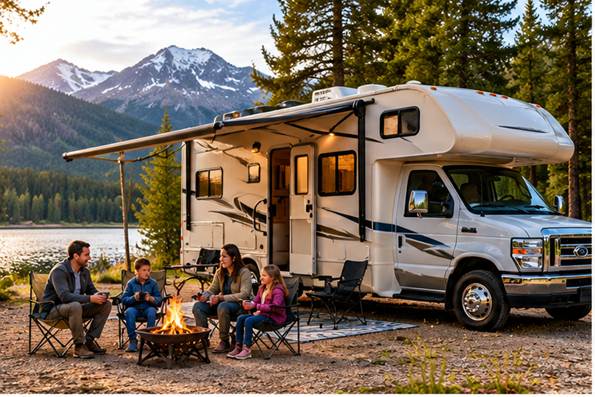
Figure 1. Common RV types: Campervans, Class C motorhomes and Class A motorhomes offer different combinations of space, maneuverability and living facilities.
A motorhome combines the vehicle and accommodation in one unit. It can simplify overnight stops and lets occupants move from the cab to the living area when safely parked. However, engine maintenance is part of ownership, and a large motorhome may be awkward for local sightseeing. A towable RV is a trailer pulled by a separate vehicle. You can leave it at a campsite and use the tow vehicle independently, but you must confirm towing limits, hitch equipment, braking requirements and trailer-handling skills.
Motorhomes include Class A, Class B and Class C categories in the North American market. Towables include conventional travel trailers, fifth wheels, pop-up campers, teardrops and toy haulers. A fifth wheel uses a coupling mounted in a pickup bed; a conventional trailer normally connects at the rear hitch. Never assume that a manufacturer’s advertised dry weight is the actual loaded towing weight. Water, food, batteries, gear and accessories can change the calculation substantially.
How RV systems work
Most self-contained RVs combine several small household systems. A fresh-water tank supplies sinks and showers through a 12-volt pump when there is no pressurized campsite connection. Wastewater from sinks and showers enters a gray tank, while toilet waste typically enters a black tank, although cassette and composting systems also exist. Tanks need monitoring, safe disposal and seasonal protection against freezing.
Electrical systems usually include a 12-volt battery circuit and a 120-volt or 230-volt shore-power circuit depending on the market. Batteries power lights, pumps and some electronics; an inverter can convert stored DC electricity to AC for compatible appliances. Solar panels replenish energy but cannot be treated as unlimited power. Refrigerators, heaters and cooking equipment may use electricity, gas or diesel, depending on design. Before purchase, ask a dealer to demonstrate every system with shore power disconnected and then connected.
Which features actually matter?
Start with legal passenger seating, not just sleeping capacity. A brochure that says an RV sleeps six does not guarantee six suitable seat-belted travel positions. Check the actual vehicle and applicable child-seat requirements. Then inspect bed lengths, access to the toilet at night, standing headroom, kitchen workspace, heating and cooling, ventilation and storage. A convertible dinette may be fine for occasional guests but inconvenient for everyday use.
The floorplan is often more important than decorative finishes. Walk through a normal day: where will wet shoes go, can someone prepare breakfast while another person sleeps, and can everyone use the bathroom with slide-outs retracted? Check the actual overall length, width and height, including roof-mounted accessories. A few extra feet can restrict parking, ferries, tunnels and campsite availability.
Weight, towing and safety basics
GVWR is the maximum permitted loaded vehicle weight specified by its manufacturer. Payload is the amount available for passengers, luggage, water and other carried items after accounting for the vehicle’s actual configuration. Tow ratings depend on the exact tow vehicle, engine, axle, equipment and loading. Trailer tongue or pin weight also consumes part of the tow vehicle’s available payload. For safe matching, consult the relevant vehicle certification labels, towing guide and qualified installer.
Inspect tires for age and condition, confirm service records and check for water intrusion. Test smoke, carbon-monoxide and gas detectors where fitted. Understand whether your driving license covers the vehicle’s weight and whether insurance applies in each country you plan to visit. A test drive should include reversing, turns, braking, hill starts and parking—not merely a short straight-road drive.
What does an RV cost?

Illustrative five-year example: $85,000 acquisition/setup, $22,000 total operating expense, $50,000 resale proceeds. Net cash cost is $57,000 before financing or opportunity cost. Not a market average.
Price depends on country, model year, equipment, size, construction and dealer discounts. As a dated US reference, Go RVing’s February 2026 beginner guide mentions entry-level pop-up campers around $7,000, many equipped travel trailers in the $20,000–$40,000 range, and motorhomes from roughly $70,000 to well above $200,000. These are broad market illustrations, not quotations for a specific vehicle. Used units can be cheaper to buy but more expensive to repair.
Add sales tax, registration, insurance, finance interest, storage, fuel, campsite fees, maintenance, tires and unexpected repairs. Buyers often focus on monthly payments while overlooking the total financed amount. Get a written out-the-door price and compare the APR, loan term and total repayments. If your RV requires a new tow vehicle, include that purchase in the decision.
A practical first-RV buying process
First, set a total budget rather than a vehicle-only budget. Second, shortlist two RV categories based on your actual travel patterns. Third, rent a similar vehicle for several nights if possible; it reveals layout problems that showroom visits hide. Fourth, compare floorplans and manufacturer specifications using the same fields. Fifth, inspect at least three real units and ask for written quotes.
For a used RV, arrange an independent inspection that covers the habitation area as well as the engine or chassis where applicable. Look for stains, soft floors, musty smells, failed seals, corrosion, damaged tires and non-working appliances. Verify ownership and liens through the appropriate local procedures. Keep a reserve for repairs, and do not rush because of a limited-time discount.
Questions to ask before paying a deposit
Ask for the exact model year, floorplan, vehicle identification number, factory options, loaded weight rating, delivery date and written warranty terms. Clarify whether the price includes preparation, battery, propane, hitch equipment, registration and orientation. Confirm which service center will honor warranty claims and what happens if a component is unavailable.
For rentals and test drives, ask whether mileage, insurance, deposits, cleaning, generator use and roadside support are included. The right RV is not necessarily the biggest or most expensive one: it is the vehicle whose actual specifications match your people, travel style, budget and operating constraints.
Questions readers frequently ask
Should I buy before renting?
For many first-time users, a trial rental can reveal whether the layout, size and operating routines match real travel needs.
Are advertised specifications enough?
No. Confirm the exact model year and floorplan, certification labels, seatbelts, actual payload and written supplier details.
Can I rely on an indicative price range?
Only as a starting point. Request current local quotes including taxes, options, fees and any financing charges.
Does the same advice apply worldwide?
Core comparison principles travel well, but legal weight limits, licensing, electrical standards, insurance and vehicle classifications differ by country.
Reader checklist
- Write down travel nights, passenger count and destinations.
- Set an all-in budget including running costs and a contingency.
- Compare exact model-year floorplans, not only brand names.
- Verify legal travel seats, loaded weights and driving-license requirements.
- Request written supplier quotes and warranty or rental terms.
- Keep copies of specification sources and inspection results.
International buying checklist: compare like with like
A US advertised MSRP, a UK VAT-inclusive retail price and an Australian drive-away quote are three different pricing concepts. Never put them in a single ranking after simply converting currencies. A US manufacturer may exclude freight, title, dealer preparation, registration and tax; an Australian dealer quote may include stamp duty and registration for a particular postcode; and a UK price may include VAT but exclude some delivery or optional-equipment charges. Ask each supplier for a written, itemized final amount payable for the exact model, floorplan, year and location. Record whether the vehicle is new, ex-demonstration or used, and whether it includes accessories and a warranty. Currency conversion is useful for orientation, not for declaring that importing will be cheaper.
A specification is not a promise about your actual vehicle
Motorhomes are built in combinations of chassis, floorplan, equipment packages and model years. A catalogue headline may say that a model sleeps six, yet an individual layout can have fewer legal belted travel seats. Options such as solar panels, extra batteries, awnings, air conditioning, bike racks and upgraded water tanks also change weight and cost. Compare the exact vehicle identification, build sheet and delivered specification. For used vehicles, obtain the weight plate, ownership records, maintenance invoices and an independent inspection. If a supplier cannot verify an essential figure, our future advisor should show “not verified” rather than estimate a pass.
A grounded snapshot of real vehicles in different markets
For a concrete US Class B example, Winnebago currently lists its Travato from $183,783 MSRP, with a 21-foot length and sleeping capacity of two for its published 59G/59K layouts. Winnebago explicitly excludes freight, tax, title, licence and dealer-preparation charges from its MSRP. This is a useful counterexample to the assumption that a compact campervan must be cheap. Jayco’s 2026 Redhawk, a US Class C, spans 26 feet 8 inches to 32 feet 6 inches and advertises layouts sleeping up to seven; its Ford E-450 chassis has a stated 14,500-pound GVWR. These two products serve very different users, so price per foot alone is misleading. In Britain, Swift lists its Voyager from £75,995 and Escape from £89,495 on its published motorhome range page. The UK range is not a direct equivalent to a US Redhawk, but it illustrates why country, design and specification must be displayed beside every price.
How RV utilities work without jargon
Think of a motorhome as a small house that must carry its own energy, clean water and waste. The vehicle engine and starter battery run the driving system; the habitation or house battery runs many living-area loads when disconnected from mains electricity. A shore-power hookup can run appliances and recharge batteries; solar panels contribute variable energy depending on sunlight, shade, season and installation. A freshwater tank supplies taps and showers through a pump. Grey water is used sink and shower water, while black water usually comes from a conventional RV toilet; some European and Australian designs use removable cassette toilets. Propane/LPG may fuel cooking or heating, while diesel or electric heating is used in other designs. Ask which systems actually operate without hookups, and for how long under realistic use.
The family-of-five trap: five beds is not five safe seats
Decision comparison: verify each item against the specific vehicle or supplier quote.
| Check | Why it matters | What to request |
| Legal travel seats | Sleeping capacity is not seatbelt capacity | Approved belted seating count |
| Payload | Accessories and passengers use capacity | As-delivered payload |
| After-sales support | Parts and servicing may be far away | Nearest authorised service centre |
Imagine two attractive layouts, both advertised as sleeping five. One has four approved travel seats and the other has five. The first is unsuitable for a five-person driving trip, regardless of how comfortable its beds appear. Next calculate usable payload: take the permitted loaded vehicle mass and subtract the vehicle’s real ready-to-travel mass, then account for occupants, luggage, water, bikes, pets and accessories. Water alone weighs roughly one kilogram per litre. A 100-litre tank therefore adds about 100 kilograms before counting the people or camping equipment. This is particularly important for European motorhomes marketed near a 3,500-kilogram weight threshold. Ask for actual delivered weight and manufacturer payload documentation, not a generic brochure figure.
Regional licences, width and repair networks
A UK category B licence normally covers a petrol or diesel motorhome up to 3,500 kg maximum authorised mass for post-1996 licence holders, while a motorhome above 3.5 and up to 7.5 tonnes generally requires C1. Entitlements differ for older licences and other circumstances; check the official DVLA rules. Other European countries and Australia have their own requirements. In North America, state and provincial rules vary, especially for larger or heavier motorhomes. Before purchasing an imported model, verify its width and height against the roads, parking facilities and ferries you will use. Also check whether the chassis and habitation components have authorized local service support.
Three pro tips buyers often miss
PRO TIP 1: Test the bathroom door, bed conversion and kitchen simultaneously. Some layouts look spacious until the bed blocks access to the refrigerator.
PRO TIP 2: Rent a comparable class for several nights before committing to ownership. Include a narrow road, grocery stop and campground hookup in your test.
PRO TIP 3: Photograph the weight plate, tyre placard and installed option list during the dealer visit; these matter more to safe loading than an attractive brochure.
PRO TIP 4: Get a separate quote for winterization, habitation inspection and water-damage checks, especially in colder or wetter climates.
Regional terminology can change the decision
In the United States, Class A, B and C are common motorhome categories. In Europe and the United Kingdom, shoppers often encounter campervan, coachbuilt, low-profile, overcab and A-class/integrated terminology. Australia distinguishes motorhomes, campervans, caravans and camper trailers, among other categories. A European A-class motorhome is not necessarily comparable in dimensions or price to a large US Class A diesel pusher. Use physical specifications and intended use rather than category names alone. Our future comparison tool should map local labels to shared attributes: motorized or towable, length, width, height, weight rating, travel seats, sleeping berths, payload, bathrooms and service network.
Three questions to ask before visiting a dealer
First, what is the total amount I will pay to drive or tow the exact vehicle home legally, including tax, registration, preparation and mandatory accessories? Second, what are its measured or documented payload and seating limits when equipped as delivered? Third, where will it be serviced and stored, and how quickly are parts available? These questions often reveal more than a glossy list of amenities. Ask for answers by email so quotations can be compared fairly. Do not pay a nonrefundable deposit until the refund conditions, delivery date, inspection rights and warranty scope are clear.
Questions for the supplier: printable comparison checklist
- What is the exact floorplan, model year, chassis and vehicle identification?
- Which items are included in the final on-road price and which are extra?
- How many legal travel seats and sleeping berths are in this exact vehicle?
- What is the delivered payload after installed accessories?
- What insurance, warranty, repair and roadside-assistance coverage applies?
- Which fees, mileage limits, restrictions or exclusions affect the quoted deal?
- Can I inspect or test the vehicle and receive written answers before a deposit?
Decision table: what to compare
CaravanEvent Pro Tips — save this checklist
- Confirm approved belted travel seats, not only sleeping berths.
- Ask for as-delivered payload after optional equipment is installed.
- Price service access and parts availability before choosing an import.
Sources, references and credits
- Go RVing: A Guide to Buying Your First RV (2026)
- Go RVing: Buying an RV
- US FTC: Financing or Leasing a Car
- US FTC: Buying a Used Car from a Dealer
- RVshare: Comparing RVshare and Outdoorsy
- Winnebago Travato manufacturer specification and MSRP
- Jayco 2026 Redhawk specifications
- Swift UK motorhome ranges and published prices
- Jayco Australia drive-away price methodology
- UK motorhome licence rules
- EU VAT rates by country
- Montana sales tax official guidance
- Indiana RV out-of-state tax official guidance
- FTC financing advice
- Outdoorsy published RV rental rate ranges
- Outdoorsy renter fees
- Outdoorsy rental costs breakdown
- Australian Border Force vehicle import taxes